I usually try to incorporate some humor into these posts, but when it comes to Bastard Out of Carolina, there just isn't anything funny at all. The abuse that Allison portrays so vividly is so grotesque it is hard to find anything positive in this entire novel. There seems to be no hope for any of the characters, which is pretty depressing.
Allison flips the southern gentleman on his head with her portrayal of Glen. If the southern gentleman is supposed to be noble, honorable, and a man of good character than Glen is the furthest thing from it. As a man, there are some things you just cannot do. Right up at the top of the list is putting your hands on a woman with force or without her consent. This goes doubly for a child. Glen's actions are so despicable to think about. We aren't talking about a guy who spanks his kid when she acts up; the physical and sexual abuse that Bone endures at his hands is completely senseless. I found it ironic how it is that very senselessness that leads to Bone's internalization of her guilt, as we discussed in class.
I think Allison is trying to depict Southern men as backward, insecure, and intolerant. Bone's uncles are drunken idiots who shoot each other trucks, and Glen is a monster. The men's treatment of women in South Carolina in the 1950's is violent and irrational. Allison is trying to show how the southern gentleman has fallen and the South has not evolved into a place that accepts equality of gender and race.
Sunday, April 29, 2007


Sunday, April 22, 2007
Mtorcycles+Cars=Cool Poetry!
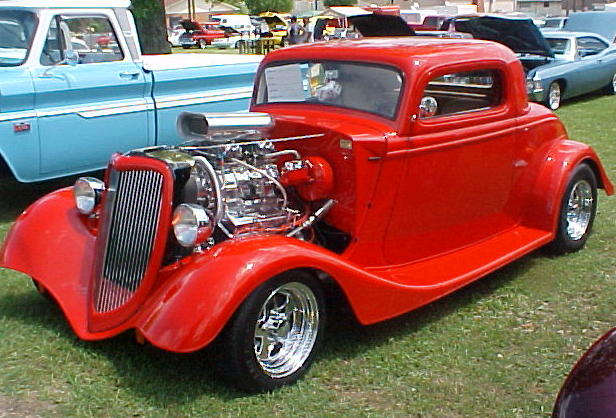
I really enjoyed the poem Cherrylog Road because it seemed like a big departure from most of Dickey's other writing. While elements of nature and religion are still found in the poem, Dickey grabbed my attention in the first two stanzas by talking about about a '34 Ford that used to be use to bootleg corn whiskey back in the day. Alright, so the car was in a junkyard and didn't look nearly that cool, but anytime someone talks about old cars that's what I think of. He keeps my attention through the next stanza by mentioning an old Essex and a blue Chevrolet. I think that the way I thought about these images is one of the themes Dickey is emphasizing in his poem--imagination and the innocence of childhood. I think the kid playing in the "parking lot of the dead" pretending he was in a stock-car race or a movie star really got my own imagination going. I used to love to imagine driving fast cars (still do), and this poem brought back those feelings of nostalgia most of us have towards our own childhoods. I have to admit that I after constantly seeing the themes of nature and religion in Dickey's poems this was a refreshing alternative. While these themes are still in Cherrylog Road, I felt like they took a backseat to the innocence displayed by this guy playing around in a junkyard full of sun-beaten, rotted-out cars.
I also have to admit that I have no idea who Doris Holbrook or her significance is in the poem. I also am not sure whether the main character is a kid or a grown man. I thought it was a kid the whole way through until I got to the end and he says he got to his motorcycle and takes off. At first I thought it was a man, but then I thought it could have been a kid pretending his bicycle was a mean motorcycle. Either way, I think the theme is the same--it's either a man nostaligic for his youth or a kid who makes us feel that same nostalgia.
I also have to admit that I have no idea who Doris Holbrook or her significance is in the poem. I also am not sure whether the main character is a kid or a grown man. I thought it was a kid the whole way through until I got to the end and he says he got to his motorcycle and takes off. At first I thought it was a man, but then I thought it could have been a kid pretending his bicycle was a mean motorcycle. Either way, I think the theme is the same--it's either a man nostaligic for his youth or a kid who makes us feel that same nostalgia.
Sunday, April 15, 2007
Poetry is Weird

I have to admit, I probably haven't read any poetry since I graduated high school. I read several of the Dickey poems, and really didn't feel like I knew what he was talking about in any of them, other than that he appears to really like nature, which is cool. I actually like poetry because I feel like most poems are so vague and ambiguous that I can make them mean almost anything anyone wants them to. So, it would probably help to show you how this poem looked inside my head.
I'd have to say my favorite of the poems I have read so far is "The Heaven of Animals." Dickey seems to be comparing the assumed innocence of cute wild animals to their primal instincts by framing his poem in "the circle of life." The poem starts out talking about "soft eyes", which made me think of little baby animals. While he never mentions what animal he specifically is talking about (maybe all, maybe a specific one) I was thinking about lions while reading this. Dickey says they have no souls, and "their instincts wholly bloom." I took this as meaning the cute little baby lion in my head is growing up and its instincts are taking over, telling my lion that he is "more deadly than he can believe" and must hunt and kill to survive. I think that Dickey is trying to compare the percieved innocence of the wild that some see to the actual hunting, kiling, and gore that it takes to survive.
I have no idea why Dickey wrote this poem. Maybe he just really loved nature and wild animals. Maybe this is a metaphor. If it is, it could be a metaphor for all kinds of ideas related to human survival and violence. Maybe he is saying to people who view nature and animals as "better" than humans that animals are just as violent and brutal as men. Perhaps he is saying that every creature on earth has their instincts that tell them to survive, no matter what. He also says something that I found interesting, even though I have no idea what he meant by it: "Having no souls, they have come,/anywyay, without their knowing." It is unclear whether he is saying that just animals have no souls, or noone has souls, or if he means the animals are better/worse off for not believing in God and afterlife.
I feel like I haven't said anything with any actual meaning in this blog. I wonder if that's what poets want when they write-to create an intentional confusion on the part of the reader that provokes all kinds of different interpretations of their work. Or maybe Dickey is rolling in his grave with frustration at my stupidity. Either way, I like being able to look at these poems from basically any angle and making them fit my argument, whatever it is.
Sunday, April 1, 2007
I liked him better as Don Corleone

The movie "A Streetcar Named Desire" is much different from the play. Most of the differences have to do with the characters being different from how we pictured them when reading the play. I think this is most obvious in Blanche's case. In the play, we see her as being a tragic figure who falls from grace and the "Old South" aristocracy to the slums of New Orleans and eventually a mental institution. When the movie begins, Blanche already appears to have lost it. This creates a much more hysterical, annoying character that I felt much less sympathy for than the character in the book-which says a lot. Vivien Leigh, the actress who plays Blanche, never stops moving. She is always bouncing around the set, in and out of the lights (mostly out), which automatically makes her look suspicious and the viewer immediately distrusts her. We don't really see Blanche this hysterical in the play until about Scene 10, after Stanley has confronted her, Mitch has left her, and she is dressed in a dirty, wrinkled gown.
Unfortunately, I have seen the movie several times before, and it is impossible for me to see Stanley Kowlaski as anyone other than Marlon Brando. When we talked in class about the actor who played Mitch originally being cast as Stanley, it did make sense to me because it would seem to be truer to Tennessee Williams' original vision for the play. "I have always been more interesting in creating a character that contains something crippled."(629) Physically, there is nothing crippled or defective about Brando's Stanley. "Mitch" was obviously not as physically attractive as Brando. The only defect I see in Stanley in the movie is his violent temper-but this seems to be the an intrical part of what Stella finds attractive about him. If Stella is his only weakness (as we see after the leaves him after the poker game and goes to Eunice's, only to return to Stanley begging for her kn his knees), then he has to maintain this primitive rage because it is a big part of what makes him so "manly" in this role. Stella tells him to clear the table, and he smashes the dishes all over the apartment. I'm willing to bet that she secretly liked this "abuse" a little bit, kind of how she liked it when he smashed all the light bulbs with her shoe on their wedding night. Clearly, this rage becomes a serious danger when he rapes Blanche-which still, like the play, leaves Stanley's motives for raping Blanche in question.
Stella didn't appear to change too much from the play to the movie. She seems the weak person who does everything for Blanche and Stanley and nothing for herself. Despite being the third best looking person on screen most of the movie, Stella comes off as more sexual in the movie than in the play. When she returns to Stanley, he is on his knees and she stands, which shows the power she does have over Stanley, even if it isn't visible most of the time. She kisses him and runs her hand over his back, almost scratching it-I had forgotten about that scene but it really shows Stella as a very sexual being. I thought it was interesting, then, that they used such a plain looking actress for this role instead of a they typical gorgeous actress. Maybe they were trying to go along with Williams' intentions of showing all facets of American life, and not the typical version that Hollywood always presents us.
Sunday, March 25, 2007
Throw Some Deees...ire's On It

I found the dynamic between Blanche and Stella in A Streetcar Named Desire very interesting. They seem very close, but Tennessee Williams makes it clear that they have some underlying problems that they sort of dance around.
In Scene Three, Blanche playfully flirts with Stanley while Stella is out on the porch. While it seems she does this to try and sway Stanley away from the conversation he wants to have about what happened to Belle Reve, it doesn't seem very sisterly nonetheless. After Stanley has had enough of her nonsense, she gets serious: "A woman's charm is fifty percent illusion, but when a thing is important I tell the truth, and this is the truth: I haven't cheated my sister or you or anyone else as long as I have lived."(644) Moments after her attempt to seduce her sister's husband fails, she uses her sister as support for why she hadn't cheated anyone, insinuating that she loves her sister so much she would never cheat her. Makes sense, but not quite so much given the timing. I believe that if Blanche thought for a second she could wiggle her way out of her difficult situation with Stanley by sleeping with him, she would have. Ironic, given that Stanley rapes her at the end of the play and she ends up getting shipped off to a mental institution.
Another scene I found interesting was the first time Blanche and Stella sit down and chat after Blanche arrives in New Orleans in Scene One. We really see how dramatic Blanche is and how Stella just takes it all with a grain of salt. Stella says, "You never did give me a chance to say much, Blanche. So I just got into te habit of being quiet around you."(635) Not only that, while Blanche's weakness is vanity, Blanche tells Stella she has gained weight and makes her stand up and be inspected. Again, Stella just complies. Williams sets Blanche up as the domineering sister and Stella as the weaker, compliant sister right at the beginning of the play. In the first scene alone there are at least three references in the stage notes to Stella "complying reluctantly."
I think its kind of weird how weak Stella is depicted. Blanche is the tragic character, so maybe she has to be shown strong at first so that she can fall. Stella seems almost afraid of Blanche-and Stanley, to some extent. But it also is very clear that Stella loves her sister very much. The day after Blanche critiques Stella like she was an Top Model contestant Stella reminds Stanley to compliment Blanche on her appearance. I found their relationship so interesting because Blanche is so caught up in her make-believe world that she has lost her grip on reality and Stella loves Blanche so much that she can't drag her back into the real world for fear of hurting her. I found this more tragic than Blanche's downfall. While Blanche's undoing was her fault, Stella, with all her love for Blanche, cannot do the one thing to help Blanche the most-grab by the shoulders, shake her, and scream WAKE UP! Stella, at the end of the play, is left with the loss of her sister, which, with her new baby binds her increasingly closer and more dependent on Stanley.
Sunday, March 18, 2007
 In Hurston’s Their Eyes Were Watching God, Hurston surprised me with her views on race. While the main idea of her story is her main character Janie’s search for love, it is impossible to ignore the implications of her portrayal of both blacks and whites in early 20th century American south. Hurston differs very strongly from most black writers we have read so far in that she is not crying out for change and equality, but seems to write about what her perception is of race without trying to deal with the social inequalities of the time.
 Hurston’s character Mrs. Turner deals with Hurston’s ambiguous feelings about race, particularly her own black race. Hurston describes Mrs. Turner as “milky” with a “slightly pointed” nose, “thin lips”, and a “bas-relief” buttocks.(208) Obviously, Hurston is trying to depict Mrs. Turner as physically looking white. Mrs. Turner has some surprising views on her fellow African-Americans. “Her disfavorite subject was Negroes”, she doesn’t trust black doctors, “can’t stand black niggers,” and believes that “the black ones is holdin’ us back” from being integrated into the white community.(210) Janie, who’s “coffee and cream complexion and her luxurious hair” made Mrs. Turner see her as another black woman who is different from the average black.
Mrs. Turner, while she and Janie may look similar, represents Hurston’s idea that race is not something that is only made up by blacks. Janie does not buy into Mrs. Turner’s crazy ideas. She humors her and lets everything she says go in one ear and out the other. Race is made up by anyone who buys into the idea that the way someone is has something to do with the color of their skin. This ambivalence towards ones own race is not something that has disappeared in the years since Hurston wrote this. Chris Rock, in his HBO stand up special “Bigger & Blacker,” jokes about how he loves black people, but hates “niggers”(his word). In his mind, “niggers” are the black people who give blacks a bad name. Black people are just people with black skin, no different from whites. Likewise, organizations like the Klu Klux Klan and Aryan Nation give white people who don’t hold the same bigoted views a bad name. Hurston does a great job of exploring views on race from within a race, and showing us that not all people from the same race share the same viewpoint.
I think this is an important break from most of the writing we have read so far by African-American authors. Douglass and Wright try to unite blacks by their shared suffering, while Hurston is trying to empower blacks by not shying away from unflattering subjects. If she ignored an individual like Mrs. Turner, she would be giving an unrealistic look at race, and if all of the problems aren’t addressed, how can they be fixed?
Sunday, March 11, 2007
Black, Green, White, and Frenchies
 “The Ethics of Jim Crow” by Richard Wright sheds a very unique light on the Jim Crow laws of the South. It was very reminiscent of Frederick Douglass’ narrative in that it was an account from a southern black man with the intention of exposing the racial tension and problems in the American south. This is by no means a romantic portrayal of the South but is meant to show how cruel an environment early 20th century southern life was for African-Americans.
 For Wright, the differences between whites and blacks come very clear to him at an early age. I found it interesting how Wright uses colors to describe the differences at the beginning of the text. He uses three colors in the first chapter a number of times: white, black and green. The white and black shouldn’t need too much of an explanation, but I liked how he used the color green, trees, bushes, and nature to describe the white’s property (although the houses are white, of course). White people had big lawns, trees, and bushes while blacks had a “skimpy yard with black cinders.”(548) The first difference begins not with any physical or mental comparison, but a comparison of property. Not only is the white’s property more pleasant to look at, but proves dangerous for blacks, as the white find cover in the trees and bushes while throwing bottles at the black kids who are armed merely with cinders and no cover. Wright says “Even today when I think of white folks, the hard, sharp outlines of white houses surrounded by trees, lawns and hedges are present somewhere in the background of my mind. Through the years they grew into an overreaching symbol of fear.”(549) Wright has come to identify white people with the property they own, and learned to be afraid of everything about it.
Another perspective I found really interesting in this reading was the reaction of other, older blacks every time Wright comes home hurt or embarrassed because he didn’t follow the Jim Crow laws perfectly. After quitting his job at the optical company in order to walk away with his life he goes home and “When I told the folks at home what happened, they called me a fool.”(551) I would have expected support, comfort, and advice. His mom beats him when he comes home with three stitches in his neck after the white boys hit him with a milk bottle, says they were right to hit him with it, and tells Wright he should thank God they didn’t kill him.(549) I was surprised by the lack of community in Wright’s portrayal of Southern blacks. Given, this is one short piece, but there is no mention of family outside of his mother beating him. I would have thought they all the blacks would look out for, protect, and educate each other. This is not the case in Wright’s writing. He portrays his fellow blacks as strangely independent. Everyone must learn these lessons of Jim Crow life on their own.
I’d like to conclude by noting how much I enjoyed the part where Wright talks about what topics were taboo for whites to speak to blacks about. It honestly made me laugh out loud, even though I know it shouldn’t have, but some of the topics were pretty hilarious or so obvious that it was funny he included them. Among my favorites-France; the entire Northern part of the
Subscribe to:
Posts (Atom)