I usually try to incorporate some humor into these posts, but when it comes to Bastard Out of Carolina, there just isn't anything funny at all. The abuse that Allison portrays so vividly is so grotesque it is hard to find anything positive in this entire novel. There seems to be no hope for any of the characters, which is pretty depressing.
Allison flips the southern gentleman on his head with her portrayal of Glen. If the southern gentleman is supposed to be noble, honorable, and a man of good character than Glen is the furthest thing from it. As a man, there are some things you just cannot do. Right up at the top of the list is putting your hands on a woman with force or without her consent. This goes doubly for a child. Glen's actions are so despicable to think about. We aren't talking about a guy who spanks his kid when she acts up; the physical and sexual abuse that Bone endures at his hands is completely senseless. I found it ironic how it is that very senselessness that leads to Bone's internalization of her guilt, as we discussed in class.
I think Allison is trying to depict Southern men as backward, insecure, and intolerant. Bone's uncles are drunken idiots who shoot each other trucks, and Glen is a monster. The men's treatment of women in South Carolina in the 1950's is violent and irrational. Allison is trying to show how the southern gentleman has fallen and the South has not evolved into a place that accepts equality of gender and race.
Sunday, April 29, 2007


Sunday, April 22, 2007
Mtorcycles+Cars=Cool Poetry!
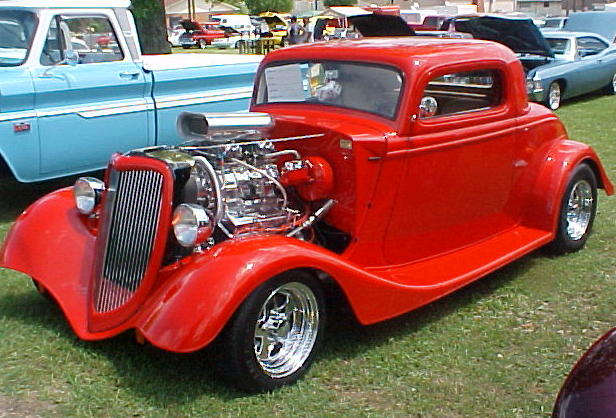
I really enjoyed the poem Cherrylog Road because it seemed like a big departure from most of Dickey's other writing. While elements of nature and religion are still found in the poem, Dickey grabbed my attention in the first two stanzas by talking about about a '34 Ford that used to be use to bootleg corn whiskey back in the day. Alright, so the car was in a junkyard and didn't look nearly that cool, but anytime someone talks about old cars that's what I think of. He keeps my attention through the next stanza by mentioning an old Essex and a blue Chevrolet. I think that the way I thought about these images is one of the themes Dickey is emphasizing in his poem--imagination and the innocence of childhood. I think the kid playing in the "parking lot of the dead" pretending he was in a stock-car race or a movie star really got my own imagination going. I used to love to imagine driving fast cars (still do), and this poem brought back those feelings of nostalgia most of us have towards our own childhoods. I have to admit that I after constantly seeing the themes of nature and religion in Dickey's poems this was a refreshing alternative. While these themes are still in Cherrylog Road, I felt like they took a backseat to the innocence displayed by this guy playing around in a junkyard full of sun-beaten, rotted-out cars.
I also have to admit that I have no idea who Doris Holbrook or her significance is in the poem. I also am not sure whether the main character is a kid or a grown man. I thought it was a kid the whole way through until I got to the end and he says he got to his motorcycle and takes off. At first I thought it was a man, but then I thought it could have been a kid pretending his bicycle was a mean motorcycle. Either way, I think the theme is the same--it's either a man nostaligic for his youth or a kid who makes us feel that same nostalgia.
I also have to admit that I have no idea who Doris Holbrook or her significance is in the poem. I also am not sure whether the main character is a kid or a grown man. I thought it was a kid the whole way through until I got to the end and he says he got to his motorcycle and takes off. At first I thought it was a man, but then I thought it could have been a kid pretending his bicycle was a mean motorcycle. Either way, I think the theme is the same--it's either a man nostaligic for his youth or a kid who makes us feel that same nostalgia.
Sunday, April 15, 2007
Poetry is Weird

I have to admit, I probably haven't read any poetry since I graduated high school. I read several of the Dickey poems, and really didn't feel like I knew what he was talking about in any of them, other than that he appears to really like nature, which is cool. I actually like poetry because I feel like most poems are so vague and ambiguous that I can make them mean almost anything anyone wants them to. So, it would probably help to show you how this poem looked inside my head.
I'd have to say my favorite of the poems I have read so far is "The Heaven of Animals." Dickey seems to be comparing the assumed innocence of cute wild animals to their primal instincts by framing his poem in "the circle of life." The poem starts out talking about "soft eyes", which made me think of little baby animals. While he never mentions what animal he specifically is talking about (maybe all, maybe a specific one) I was thinking about lions while reading this. Dickey says they have no souls, and "their instincts wholly bloom." I took this as meaning the cute little baby lion in my head is growing up and its instincts are taking over, telling my lion that he is "more deadly than he can believe" and must hunt and kill to survive. I think that Dickey is trying to compare the percieved innocence of the wild that some see to the actual hunting, kiling, and gore that it takes to survive.
I have no idea why Dickey wrote this poem. Maybe he just really loved nature and wild animals. Maybe this is a metaphor. If it is, it could be a metaphor for all kinds of ideas related to human survival and violence. Maybe he is saying to people who view nature and animals as "better" than humans that animals are just as violent and brutal as men. Perhaps he is saying that every creature on earth has their instincts that tell them to survive, no matter what. He also says something that I found interesting, even though I have no idea what he meant by it: "Having no souls, they have come,/anywyay, without their knowing." It is unclear whether he is saying that just animals have no souls, or noone has souls, or if he means the animals are better/worse off for not believing in God and afterlife.
I feel like I haven't said anything with any actual meaning in this blog. I wonder if that's what poets want when they write-to create an intentional confusion on the part of the reader that provokes all kinds of different interpretations of their work. Or maybe Dickey is rolling in his grave with frustration at my stupidity. Either way, I like being able to look at these poems from basically any angle and making them fit my argument, whatever it is.
Sunday, April 1, 2007
I liked him better as Don Corleone

The movie "A Streetcar Named Desire" is much different from the play. Most of the differences have to do with the characters being different from how we pictured them when reading the play. I think this is most obvious in Blanche's case. In the play, we see her as being a tragic figure who falls from grace and the "Old South" aristocracy to the slums of New Orleans and eventually a mental institution. When the movie begins, Blanche already appears to have lost it. This creates a much more hysterical, annoying character that I felt much less sympathy for than the character in the book-which says a lot. Vivien Leigh, the actress who plays Blanche, never stops moving. She is always bouncing around the set, in and out of the lights (mostly out), which automatically makes her look suspicious and the viewer immediately distrusts her. We don't really see Blanche this hysterical in the play until about Scene 10, after Stanley has confronted her, Mitch has left her, and she is dressed in a dirty, wrinkled gown.
Unfortunately, I have seen the movie several times before, and it is impossible for me to see Stanley Kowlaski as anyone other than Marlon Brando. When we talked in class about the actor who played Mitch originally being cast as Stanley, it did make sense to me because it would seem to be truer to Tennessee Williams' original vision for the play. "I have always been more interesting in creating a character that contains something crippled."(629) Physically, there is nothing crippled or defective about Brando's Stanley. "Mitch" was obviously not as physically attractive as Brando. The only defect I see in Stanley in the movie is his violent temper-but this seems to be the an intrical part of what Stella finds attractive about him. If Stella is his only weakness (as we see after the leaves him after the poker game and goes to Eunice's, only to return to Stanley begging for her kn his knees), then he has to maintain this primitive rage because it is a big part of what makes him so "manly" in this role. Stella tells him to clear the table, and he smashes the dishes all over the apartment. I'm willing to bet that she secretly liked this "abuse" a little bit, kind of how she liked it when he smashed all the light bulbs with her shoe on their wedding night. Clearly, this rage becomes a serious danger when he rapes Blanche-which still, like the play, leaves Stanley's motives for raping Blanche in question.
Stella didn't appear to change too much from the play to the movie. She seems the weak person who does everything for Blanche and Stanley and nothing for herself. Despite being the third best looking person on screen most of the movie, Stella comes off as more sexual in the movie than in the play. When she returns to Stanley, he is on his knees and she stands, which shows the power she does have over Stanley, even if it isn't visible most of the time. She kisses him and runs her hand over his back, almost scratching it-I had forgotten about that scene but it really shows Stella as a very sexual being. I thought it was interesting, then, that they used such a plain looking actress for this role instead of a they typical gorgeous actress. Maybe they were trying to go along with Williams' intentions of showing all facets of American life, and not the typical version that Hollywood always presents us.
Subscribe to:
Posts (Atom)