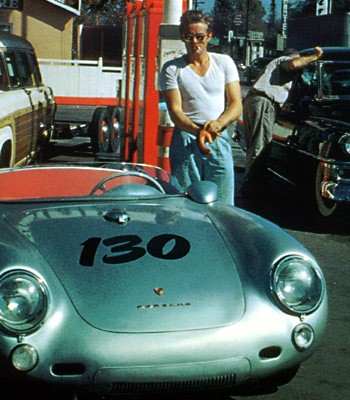
I really enjoyed the poem Cherrylog Road because it seemed like a big departure from most of Dickey's other writing. While elements of nature and religion are still found in the poem, Dickey grabbed my attention in the first two stanzas by talking about about a '34 Ford that used to be use to bootleg corn whiskey back in the day. Alright, so the car was in a junkyard and didn't look nearly that cool, but anytime someone talks about old cars that's what I think of. He keeps my attention through the next stanza by mentioning an old Essex and a blue Chevrolet. I think that the way I thought about these images is one of the themes Dickey is emphasizing in his poem--imagination and the innocence of childhood. I think the kid playing in the "parking lot of the dead" pretending he was in a stock-car race or a movie star really got my own imagination going. I used to love to imagine driving fast cars (still do), and this poem brought back those feelings of nostalgia most of us have towards our own childhoods. I have to admit that I after constantly seeing the themes of nature and religion in Dickey's poems this was a refreshing alternative. While these themes are still in Cherrylog Road, I felt like they took a backseat to the innocence displayed by this guy playing around in a junkyard full of sun-beaten, rotted-out cars.
I also have to admit that I have no idea who Doris Holbrook or her significance is in the poem. I also am not sure whether the main character is a kid or a grown man. I thought it was a kid the whole way through until I got to the end and he says he got to his motorcycle and takes off. At first I thought it was a man, but then I thought it could have been a kid pretending his bicycle was a mean motorcycle. Either way, I think the theme is the same--it's either a man nostaligic for his youth or a kid who makes us feel that same nostalgia.


Subscribe to:
Post Comments (Atom)





5 comments:
I thought that "Cherrylog Road" was a very interesting poem. Like you said the themes of religion and animals aren't as strong in this particualr poem, but there is still a sexual theme that seems to be reoccuring in many of his poems as well. I liked how the poem was very imaginative, all leading to the meeting scene of the narrator and Doris. The whole time he is just making up stories about these old cars to fill his time while he awaits his, what seems to be, forbidden lover.
I always enjoy reading your blog entries, and you kept me especially entertained with the incorporation of clicking the links to view pictures of the words. I felt the same way when I read this poem that I had no idea who Doris was or what her significance was, but I usually don't ever understand what the poet is trying to say in his poems unless I am given somewhat of a hint.
I agree with Amanda. I think that Doris represents this sexual being. A forbidden love that the author cannot have. And together they are breaking the rules of society in order to be together. There is something mysterious about their love because we never really know who the author is or Doris. They are too people with no real identity in the poem.
I also always enjoy reading your blogs.. it's always full of good stuff, and you always come up with interesting ideas and twists on what we're reflecting on. I agreed with you about how this poem is a breath of fresh air compared to the other poems, in terms of the natural elements. I thought this poem was fun, and I can absolutely imagine him rummaging through the junk yard using his imagination and exploring everything.
Matt,
I agree that “Cherrylog Road” definitely stood out from the rest of Dickey’s poems. Even for starters, I feel like it was much easier to follow, for it was the only one that I found to be really narrative. I also feel that the “innocence of childhood” as you stated is a very prevalent theme in many of his poems, especially this one. I feel for this one however, that the innocence is lost in this illicit love affair between the two teenagers. I feel that they are teenagers for it is still forbidden for them to court one another (at least with the knowledge of her father), yet they are each old enough to drive and go out on their own. I feel that this narrative poem does have a touch of nostalgia to it, however I feel that it is of an experience that a man had when he was younger, of the turning point in his life of when he was no longer innocent anymore.
Post a Comment